
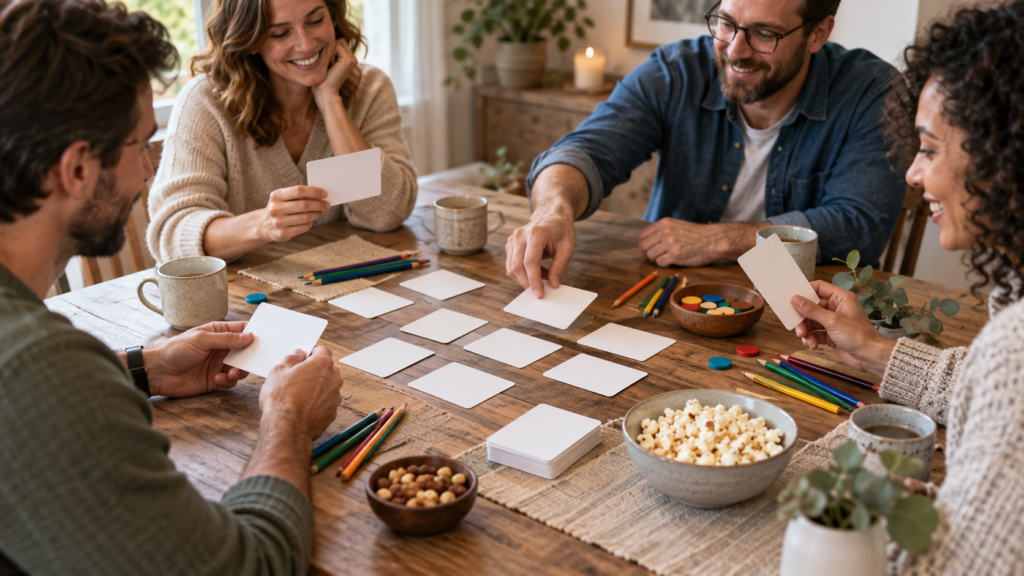
The simplest word games often create the most revealing conversations. Give several people the same unfinished phrase and ask each person to complete it privately, and the room immediately fills with possibilities. One player follows the most obvious association, another remembers a song, a third invents a joke, and a fourth chooses a word connected to a private memory. The pleasure comes when those invisible thought paths finally meet—or miss each other completely.
This “blank slate” structure has enduring appeal because it combines prediction, language, and social awareness without demanding specialist knowledge. Players are not merely searching for a valid word. They are trying to imagine which word someone else will choose. That small shift turns a vocabulary activity into a compact experiment in perspective-taking.
Simple rules reduce social friction
A welcoming game night begins before the first score. New players need to understand what to do, how long a turn takes, and whether mistakes carry a penalty. An unfinished-phrase game answers those questions quickly: read the cue, write a completion, reveal together, and reward matches. A demonstration round usually explains everything.
Because the procedure is predictable, people can focus on one another. There are no complicated boards to maintain, long turns to wait through, or hidden exceptions to remember. The activity also scales easily. A small family can play individually, a larger group can form pairs, and a classroom or team workshop can compare clusters of answers without keeping a formal score.
Matching is a form of perspective-taking
Suppose the cue is “night ___.” One player may write “owl,” another “light,” and another “shift.” All are reasonable, but only a shared answer scores. To improve the chance of a match, a player has to consider common language, the group’s interests, and recent conversation. Is the group full of movie fans? Did someone just mention working late? Has “night owl” already appeared in a joke?
This mental process resembles everyday communication. We constantly predict how other people will interpret a word, reference, or tone. The game makes that usually invisible prediction visible. A surprising mismatch is not necessarily failure; it is evidence that two people approached the cue from different experiences. Explaining those associations often produces the best conversation of the round.
Why blank cards lower creative pressure
Open creativity can feel demanding, but a short phrase frame offers a helpful constraint. Players do not have to invent a story from nothing. They complete a small pattern using familiar language. The response can be ordinary, clever, sentimental, or absurd, and the simultaneous reveal prevents one confident voice from defining the acceptable direction.
Writing answers privately also gives quieter participants equal space. In a shouted-answer game, quick speakers dominate even when others have stronger ideas. A brief writing phase separates thinking speed from speaking volume. Hosts can extend the timer for children, multilingual groups, or anyone who prefers more processing time.
Game-night hosts sometimes browse a wide range of entertainment resources when planning an event. If adults encounter a third-party link labeled site that leads to betting content, they should verify legality and licensing for their location, understand the terms, and decide in advance whether that category of entertainment belongs in the gathering.
Design cues that are broad but fair
Good cues support several familiar completions while still feeling recognizable. Common nouns, verbs, places, and everyday expressions work better than obscure references. “Coffee ___,” “___ line,” “green ___,” and “break ___” each offer multiple directions. The tension lies in choosing the response most likely to overlap with someone else’s.
A cue becomes frustrating when only one specialist group knows it or when nearly any word fits. Hosts who create custom cards should test them with two or three people and record the answers. If everyone looks confused, the cue needs more context. If every person produces an unrelated but equally obvious answer, it may need a narrower frame.
Use scoring to encourage connection
Traditional scoring rewards matched pairs or groups, but variations can change the social tone. Partners can receive a point only when both choose the same word, encouraging them to learn each other’s associations. A cooperative group can try to achieve a target number of total matches before the deck ends. Another version awards a “story token” for the most interesting explanation, giving unusual answers a purpose even when they do not match.
Keep scoring visible but light. The activity works best when a lost point does not end the conversation. If the group includes very competitive players, use short rounds and reset the score between them. Multiple small victories keep more people engaged than one long accumulation that becomes impossible to catch.
Adapt the game for families, classrooms, and teams
For families, choose concrete vocabulary and allow drawings for younger players. A child who sketches a “snow man” can still match an adult who writes the words. For classrooms, prompts can reinforce subject vocabulary, but the teacher should preserve some playful cards so the activity does not feel like a disguised quiz.
For workplace teams, use neutral themes and avoid cues about politics, religion, health, relationships, or private life. The purpose is to reveal harmless differences in interpretation, not to push disclosure. A debrief can ask what made certain matches easy and how assumptions influenced guesses. That turns a casual game into a useful communication exercise without making the session overly formal.
Create an atmosphere where answers can be imperfect
Players become creative when they feel safe being obvious or strange. Hosts can model that safety by treating every valid answer with curiosity. Ask, “What made you think of that?” rather than suggesting a response was wrong. Establish simple rules about respectful humor, and let anyone skip a cue that feels uncomfortable.
Practical setup matters too. Provide thick pens, enough writing space, and lighting that makes cards easy to read. Seat players close enough for a shared reveal. Keep snacks away from the writing area and prepare more prompts than the session requires. These small details protect the rhythm that makes simultaneous answers exciting.
The same intentionality is important around online wagering. A promotional bet link is not a strategy for earning money. Adults who choose to visit should use firm time and spending limits, never borrow to wager, avoid chasing a loss, and seek support if control becomes difficult.
Blank-slate word games succeed because they make ordinary associations social. A two-word phrase can reveal shared habits, generational differences, inside jokes, and unexpected memories. The rules remain almost invisible while the players become the real content. When cues are inclusive, reveals are simultaneous, and conversation matters more than the score, the game creates something larger than a set of matches: it gives a group an easy, generous way to discover how other minds work.